Utah's Market is Growing: Does Your Business Stand Out?
You know the question is coming. Every marketer, every agency, every potential partner will eventually ask: "What makes your business different?" And if you're like 70% of business owners that we talk to in Utah, you'll default to something like: "We provide quality service and really care about our customers."
That's not a differentiator. That's the baseline. That's what every business should be doing at minimum.
Here's the problem: if you can't articulate why your business is special, neither can your website, your Google Business Profile, your social media, or your paid ads. And in today's competitive Utah market, where 50,000 new residents are entering the state annually, generic messaging gets buried.
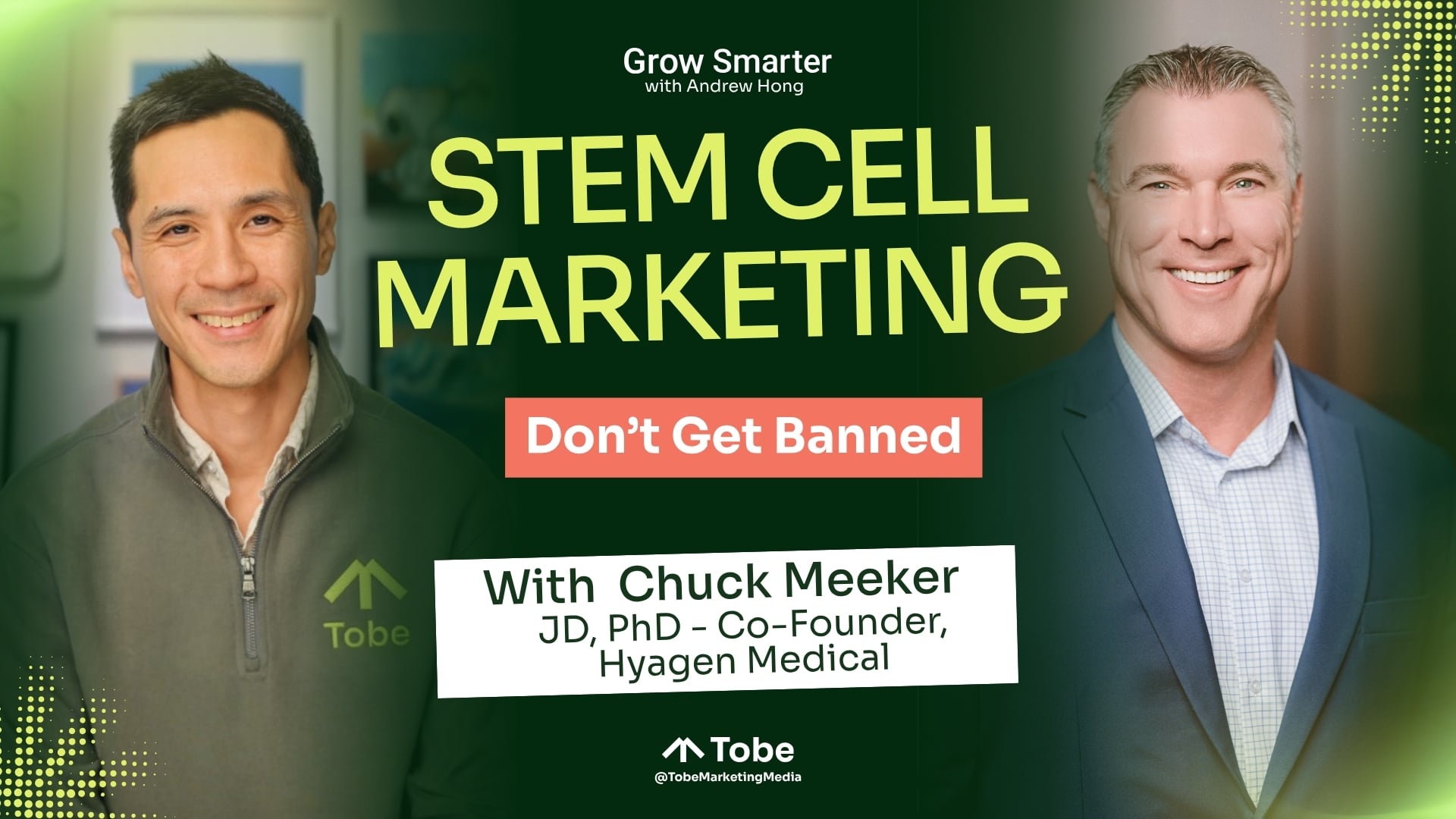
In this episode of Grow Smarter Utah, Andrew Hong from Tobe Agency sat down with Brayden from Be Social to discuss what actually works for Utah businesses in 2026, what's wasting your time, and the single biggest opportunity most business owners are completely missing.
Key Takeaways:
- 70% of business owners can't clearly articulate what makes them different. If that's you, start there before spending on marketing.
- Quality Google Business Profile media delivers 42% more direction requests. Your photos matter more than you think.
- DIY media is the "unpermitted shed house" approach. The upfront savings usually cost more in lost conversions.
- Authenticity beats trends. Stop chasing TikTok dances if they don't fit your personality.
- Foundational media is an investment, not an expense. $1,000-4,000 today serves your website, GMB, and ads for 3-5 years.
- Your brand is constantly evolving. Keep your marketing materials current with who you are now.
The 70% Problem: Why Most Utah Businesses Sound the Same
When Brayden sits down with potential clients to understand their brand, something troubling happens consistently.
"I'd say 70% of the time, I get the generic answer," Brayden explains. "They say, 'We provide good quality service and we care about our customers.' I've heard that story a million times. That's what every business needs to do at a minimum."
The remaining businesses break down into two camps: about 20% can actually articulate what makes them different when pushed, and a concerning 10% literally have no idea what sets them apart.
This isn't just a branding problem—it's a revenue problem. Without a clear value proposition, every marketing channel underperforms: your website doesn't convert, your ads blend into the noise, and AI search engines have nothing unique to surface about your business.
The fix isn't complicated. It requires sitting down and honestly answering three questions: What do you do? What makes you special? How do you make your customers' lives better?
If you can't answer those succinctly, you're not ready for marketing. You're ready for brand messaging work.
First Impressions Happen in 3 Seconds (And Your Photos Are Failing)
Profile get 42% more direction requests and 35% more click-throughs than those without.
Think about that. Nearly half of your potential foot traffic could be going to a competitor simply because their photos look better than yours.
Brayden shared a scenario that plays out constantly: "I've seen people with really nice facilities take crappy photos that doesn't really represent their clinic well.
People look at it and think, 'I don't know,' because you have three seconds to make an impression. If that impression isn't good, they're more likely to swipe through."
The disconnect is especially damaging for businesses targeting younger demographics (18-40).
This generation grew up on Instagram. They've been conditioned to expect polished visuals. When they search for a wellness clinic, med spa, or local service and see grainy photos of a dingy waiting room, they click to the next result.
Your 100 five-star reviews won't save you if your media tells a different story than those reviews.
DIY Media: The Un-permitted Shed House Approach
There's a tendency among entrepreneurial Utahns to DIY everything. Sometimes that works. For media? Usually not.
"I always think about the DIY folks who built that unpermitted shed house in their backyard," Andrew explains. "You can tell it's not level. There are random nails sticking out. It looks like it's gonna get blown down in the next windstorm."
"If you DIY your media and don't really know what you're doing, you're presenting that shed house—nails exposed, not leveled, about to fall over. That's not the foundation to start your business on."
The math actually works against DIY for most businesses. A foundational media package from a professional runs $1,000 to $4,000. That content lives on your website, Google Business Profile, and marketing materials for 3-5 years. That's a cost of roughly $20-65 per month when amortized.
Compare that to the opportunity cost of low-quality media: fewer clicks, fewer calls, and fewer customers choosing you over the competitor who invested properly.
Stop Chasing TikTok Dances: Why Authenticity Beats Trends
One of the worst things agencies do to small business owners? Force them into inauthentic content.
"I fault a lot of agencies for making business owners do stupid TikTok dances," Andrew says. "It was a trend and they tried to hijack it, but it wasn't the personality of the business owner. You'll be shocked at how many times I hear, 'They made me do these TikTok dances. I'm not comfortable.' And when I look at the content, yeah—they don't look comfortable."
Brayden's advice is straightforward: "Agencies chase trends, which ends up being like a dog chasing its tail. If it's inauthentic, people can tell. We're very good at reading through the BS. If they see it's not who you are, it might be funny—but funny in the wrong way. That affects your business."
The solution isn't avoiding video. It's finding the format that fits your personality. For camera-shy owners, that might mean interview-style content where someone asks questions about what you're an expert in. You can talk about your business at 3 AM with five kids behind you. Let the professional handle making it look good.
The New Business Playbook: Where to Invest First
If you're starting a business in Utah and have limited budget—which is most people—Brayden's advice might surprise you.
"Most businesses that are starting out, we tell them: social media may not be the right first step. If it's organic, it takes even longer than 60-90 days unless you have enough of the right people advocating your brand for you."
For new businesses, the priority order looks like this:
- Brand messaging and story – Know what makes you different before spending a dollar on marketing
- Quality foundational media – Photos and videos of your actual business, team, and facility ($1,000-4,000)
- Google Business Profile optimization – Keyword research, quality images, and proper setup for local search
- Website – Not a single-scroll page with no pricing or services—an actual website that converts
Social media comes later. Paid social even later than that. These channels work best when you have a brand foundation that actually converts.
For Established Businesses: Finding New Angles
If you've been operating for years and your brand has grown stale, the approach is different. Brayden looks at the history: who are your returning customers, what do they say about you, why do they choose you over competitors?
"I've seen a lot of businesses where they're growing and they push hard on growth, but as far as brand image, they're just coasting," Brayden notes. "They've got enough revenue but aren't doing anything to grow the brand."
The opportunity is often right in front of you. Maybe it's finally putting the founder on camera. Maybe it's showcasing that new piece of equipment or expanded service offering that your existing customers don't even know about.
"There's nothing more frustrating than when people say, 'I didn't even know you did that,'" Brayden adds. "That's a sign you need to do better at making sure people understand who you are and what you offer."
Ready to Stop Guessing?
If you can't explain what makes your business different in a few sentences, that's the first problem to solve. If your Google Business Profile has low-quality photos while your competitor's looks polished, that's the next problem.
Marketing only works when the foundation is right. Waste less. Grow smarter.
Need help with content creation and brand strategy? Talk to Brayden at Be Social @ bsocialnow.net
Need SEO, paid ads, or a website that converts? Talk to Tobe Agency @ TobeAgency.co
FAQ: Utah Small Business Content
-
What percentage of business owners can't explain what makes them different?
According to Brayden from B Social, approximately 70% of business owners give generic answers like "quality service" or "we care about our customers" when asked what makes their business different. Another 10% openly admit they don't know what sets them apart. Only about 20% can clearly articulate their unique value proposition when prompted to dig deeper.
-
How much do Google Business Profile photos affect customer behavior?
Businesses with quality media on their Google Business Profile receive 42% more direction requests and 35% more click-throughs compared to profiles with low-quality images. Since customers make first impressions within 3 seconds, poor photos can send potential customers directly to your competitors—even if your actual facility is excellent.
-
Should I DIY my business media or hire a professional?
For most businesses, professional media is worth the investment. DIY media often presents what Andrew calls the "unpermitted shed house" problem—it looks unpolished and can actually hurt your credibility. A foundational media package typically costs $1,000-4,000 and serves your website, Google Business Profile, and marketing materials for 3-5 years. When amortized, that's roughly $20-65 per month—far less than the cost of lost customers from poor first impressions.
-
What should new businesses invest in first for marketing?
The recommended priority order for new businesses is: (1) Brand messaging and story—know what makes you different before spending on marketing, (2) Quality foundational media—professional photos and videos of your actual business, (3) Google Business Profile optimization with proper keywords and images, (4) A website that actually converts visitors into customers. Social media and paid advertising should come later, after the foundation is solid.
-
Why do agencies push business owners to do TikTok dances?
Many agencies chase trends to show quick activity, but forcing business owners into content that doesn't match their personality backfires. People can tell when content is inauthentic—it might be funny, but funny in the wrong way that damages your brand. The better approach is finding content formats that fit your personality, like interview-style videos where you discuss topics you're genuinely expert in.
-
How long should foundational business media last?
Professional foundational media typically remains relevant and usable for 3-5 years across multiple channels—your website, Google Business Profile, social media, and paid advertising. This multi-channel utility is what makes the upfront investment worthwhile. The key is creating timeless content that represents your brand accurately rather than chasing trends that quickly become dated.
-
What brand assets do I need before creating quality content?
At minimum, you need a brand guide that includes your logo variations, brand colors, and visual identity standards. This ensures consistency across all your marketing materials—from video captions to website design. If someone can't recognize your brand without seeing your name or logo, you need stronger brand markers that create instant recognition and association.
-
Is organic social media reach dead?
No, but it has declined 60-70% since 2022. The fallacy is thinking this means you shouldn't try. Organic reach has declined because there are more people and more content competing for attention—not because the platforms stopped working. Quality content that grabs attention, provides value, and delivers a payoff still performs well. The businesses that struggle are those pumping out low-quality content hoping something sticks.
-
What makes content "quality" if not expensive equipment?
Quality content isn't about cameras and studio lights. Quality content grabs attention, provides value, and has a payoff for the viewer. You can achieve this with a phone camera if the story is good. Professional equipment helps you stand out slightly more, but the fundamentals—hook, value, payoff—matter far more than production value. Many phone-shot videos outperform expensive productions because the content itself resonates.
-
How do I know if I need brand messaging work before marketing?
Ask yourself: Can you explain what makes your business different from competitors in one or two sentences? Can you describe how you make your customers' lives better? If you default to generic answers like "quality service" or struggle to articulate your value proposition, you need brand messaging work before investing in ads, SEO, or social media. Marketing amplifies your message—if the message is unclear, marketing just amplifies confusion.
Read the Edited Transcript
I. Introduction & The Utah Growth Explosion
Andrew: Hey, welcome to Grow Smarter, Utah, brought to you by Toby Agency and B Social. As a Utah business owner, you know the pressure of making every marketing dollar count. Our mission is to help you waste less and grow smarter with your marketing investments, focusing on what actually works in the Utah market. Today we're tackling something every Utah business owner is struggling with: social media. You're posting, maybe even running some ads, but you're not seeing any real results. Meanwhile, your competitor just down the street seems to be crushing it. We're breaking down exactly what's working for Utah businesses in 2026, what's a waste of time, and the single biggest opportunity most people are completely missing.
I'm Andrew Hong, the founder of Toby Agency. I handle the technical side—SEO, paid ads, analytics, and conversion tracking. We also have Brayden from B Social, who specializes in content creation and organic social strategy for local Utah businesses. Today, we're going to show you how to think about creative content and digital strategy working together to actually grow your business. Brayden, good to have you on here.
Brayden: Doing good, man. Excited to kick this off. It’s going to be a lot of fun.
Andrew: For viewers who don't know you, can you tell me a little bit about B Social and what you guys focus on?
Brayden: B Social is a social media marketing agency focused on creating content for organic reach. We help grow your brand online through strategic content, making sure that when people see you, you're being heard and seen, but also that you are growing your audience. It’s about exposure that truly represents your brand. A lot of people just throw the spaghetti at the wall and hope something sticks. In reality, it is a very strategic thing you have to implement; otherwise, people will be confused about who you are or what you offer. We come up with the strategy, create the content, post it, and manage it—everything.
Andrew: I connected with you, Brayden, through our love of cars. I actually hired you to take pictures of a Porsche I had that is no longer in my garage, unfortunately. But when I met you, what stood out was that you’ve built a community here. Utah is a hotbed for growth right now. There are 50,000 new people entering the state every year. A University of Utah report from late 2025 said the population is basically going to double in the next ten years, from 2 million to 4 million people. That is a huge opportunity, but also a challenge because competition is growing. B Social creates premium content that elevates a small business. I see so many businesses throw "junk" at the wall and wonder why their ads aren't converting. My agency doesn't specialize in creating that content—we focus on making sure that high-quality content gets in front of the right eyeballs through paid ads, SEO, or email.
II. The State of Organic Reach in 2026
Andrew: Let's talk about organic reach. Since 2022, organic reach has declined almost 60% to 70%. If you had a thousand followers on Facebook years ago, a thousand people saw your post. Now, you'd be lucky if 20 saw it. It isn’t dead, but it’s more difficult.
Brayden: It’s funny because most people look at that stat and think, "Why do I even try?" The fallacy is that it’s harder because there are more people on the platforms. What is actually harder is throwing out junk content and getting feedback. If you're throwing out crappy content, sorry, there are a billion other people doing the same thing. You have to find ways to stand out. People have to sift through the sand to find the gold.
Andrew: Pumping out quantity over quality is a surefire way to lose. What does "quality" social media content actually look like for organic reach?
Brayden: Everyone thinks they need an expensive camera or crazy studio lights. That is useful depending on your brand, but for most, you don't need it. Quality content is content that grabs attention, provides value, and has a payoff for the viewer. You can pull out a phone camera and triple the views of a nice camera if the story is good. We like bringing in the heavy-hitting equipment because it helps you look polished, but quality is about the story.
III. The 70% Messaging Problem & AI Search
Andrew: What is your process for finding that story and drawing it out of a business owner?
Brayden: It’s about understanding who the brand is and who they cater to. We talk to owners about their customer base and their reviews. Most businesses aren't doing something that hasn't been done before, so we have to find what makes you unique. I actually end up qualifying a lot of customers during this process because I find holes where they aren't in touch with their customer base.
Andrew: How often do you meet a business that can't answer "What makes you special?"
Brayden: Truthfully, the generic answer happens 70% of the time. They say, "We provide quality service and care about customers." That’s the baseline; every business needs to do that.
Andrew: Exactly. If you can't tell that story, you won't stand out—especially now that we’re optimizing for AI search engines. When someone asks ChatGPT who the best vinyl wrap company in Utah is, you won't show up if you don't have a unique story. Google and AI tools look for consistency across your website, Instagram, and Google Business Profile. If the story is different on every channel, people get confused.
IV. The Google Business Profile Opportunity
Andrew: This segues into the Google Business Profile (GBP). It is an underutilized opportunity. When people search for something "near me" or on Apple Maps, they aren't doing research on whether they need a service—they are looking for someone to buy from right now.
The biggest problem I see is that the photos on these profiles are terrible. If you’re a high-end wellness clinic but your GBP has photos of a dingy, low-lit office, you're losing. Research shows you get 42% more direction requests and 35% more click-thrus if you have better media on that profile.
Brayden: It’s about looking legitimate. There is an inherent "distrust gap" in the market. If you show up in person and the office is dirty, you’re done. People have three seconds to make an impression. For the younger generation, it’s all about aesthetics. They want to know exactly what they are going to walk into. Good photos of your lobby make it feel familiar. With dealerships, we film in the lobbies where customers spend time so that when they walk in, it already feels familiar and they drop their guard.
V. Budgeting: New vs. Established Businesses
Andrew: For a new business, what would you recommend as a foundational media package?
Brayden: For a new business, organic social might not even be the first step because it takes longer than 60 to 90 days. You need revenue now. We recommend a content package that makes you look legitimate for your ads and GBP.
Andrew: I agree. Invest in that media upfront because you can reuse it across your website, your GBP, and your paid ads. Spend that $1,000 to $2,000 on quality media first.
Brayden: We call it our "Starter Kit." It’s GBP content, the "Brand Story" video where the owner talks about why they do what they do, and maybe a couple of testimonial videos. That content will live on your site for 3 to 5 years.
Andrew: And for an established business?
Brayden: We look at their history and focus on returning customers. Many established businesses are growing but their brand image is just "coasting." We find the content pillars—why people choose you over the competition—and dial that in. It’s also about re-engaging people. If a customer only sees you once a year, they might not know about the new equipment or services you’ve added.
VI. Overcoming Camera Shyness & Authenticity
Andrew: Many business owners are afraid to get on camera. I fault agencies for making people do stupid TikTok dances that don't fit their personality. How do you handle that?
Brayden: It is difficult. The reason I got into media was because I didn't want to be the guy in front of the camera! But there are a million and a half reasons to do it. We don't make you do anything inauthentic. People can read through the BS. We just try to break down those barriers. I often advise owners not to even watch the videos at first—just let the results speak for themselves.
Andrew: You don't need a super-produced video. Just have someone interview you about what you're an expert at. You can riff on that easily. Hiring a professional means you aren't "DIY-ing" it. If you DIY your media and don't know what you're doing, you’re presenting a "shed house" with nails sticking out. That isn’t the right foundation.
VII. Final Thoughts
Andrew: The takeaways are: Define your pitch, invest in foundational media upfront, and remember that perception is reality. If you need content, brand strategy, or help standing out, talk to Brayden at B Social. If you need SEO, ads, or a website, talk to us at Toby Agency.
Brayden: Ditto. If you’re a new business, just starting is better than nothing. But when you want to take it to the next level, understand that your brand is what keeps you from being a commodity.
Andrew: Thanks for joining us. Next time, we’ll be talking about Google Ads—the "boring" but necessary stuff. Subscribe, leave a comment, and share this with another Utah business owner. We'll see you in the next episode.