Where the Longevity Patient Actually Does Their Research
If you're marketing a functional medicine, hormone therapy, or longevity practice, there's a good chance you're focused on the wrong channels.
Most practices pour their marketing budget into Google Ads, Instagram posts, and maybe some Facebook campaigns. And those channels aren't useless, but new data suggests your highest-value patients are doing their homework somewhere else entirely.
They're asking AI.
We attended a landmark keynote by Laurie Hofmann and Tom Blue. Laurie Hofmann is essentially the architect of the modern functional medicine movement, having served as CEO and Board Chair of the Institute for Functional Medicine (IFM) and helping create the Cleveland Clinic Center for Functional Medicine. Tom Blue is a visionary in concierge medicine and digital health, focused on the commercialization of longevity.

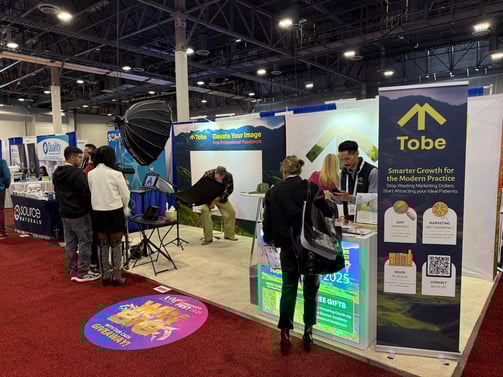
Together, they presented findings from their massive Longevity Social Listening Study, which analyzed 688,000 public posts and nearly 4 billion impressions to reveal what patients are actually talking about. Here are the 4 data-backed shifts that define the new what we call at Tobe "Investor Patient."
Your Patients Use AI Search More Than You Think
We recently pulled audience research on affluent longevity medicine and biohacking seekers, the exact demographic that pays cash for hormone optimization, peptide therapy, and comprehensive health assessments.
The data was clear: this audience uses AI-powered search tools like ChatGPT, Perplexity, and Claude up to 88% more than the general population.
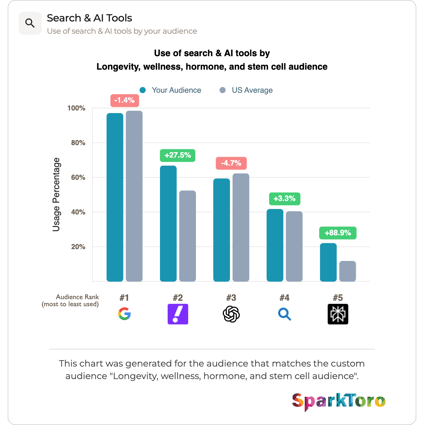
That's not a small difference. These patients aren't just Googling "hormone therapy near me" anymore. They're having conversations with AI to understand treatment options, compare protocols, research providers, and vet clinics before they ever pick up the phone.
This tracks with broader industry data. At A4M's LongevityFest 2025, OvationLab presented research showing AI/longevity discussions are up 109% year-over-year. The longevity consumer isn't just aware of AI, they're actively using it as a research tool for their health decisions.
How Longevity Patients Actually Use AI
The OvationLab study analyzed over 1.12 million posts and 6.85 billion impressions to understand how consumers engage with longevity topics online. When it comes to AI, the use cases are specific and growing fast:
Education (+80% YoY): Patients use AI to break down research papers, decode medical jargon, and summarize health threads so they can understand the science behind treatments.
Building Treatment Plans (+72% YoY): They're using AI to build supplement stacks and evaluate treatment options based on their specific diagnoses, symptoms, and lab results.
Interpreting Data (+57% YoY): Patients upload their lab panels, sleep scores, and biomarker data, then let AI translate the numbers into actionable insights.
Protocol Optimization (+25% YoY): They fine-tune their existing protocols by asking AI to compare tradeoffs and weigh risks between different approaches.
Here's what this means for your practice: your patients are showing up to consultations more informed than ever. They've already researched your treatments, compared you to competitors, and formed opinions, often based on what AI told them.
The question is whether AI is recommending you or someone else.
The AI Visibility Gap Is Real
We've been running AI visibility audits for healthcare practices, and the results are eye-opening.
One practice we analyzed had solid Google rankings, page one for their core keywords, decent local pack visibility. But when we tested how they appeared in AI recommendation queries, they showed up in only 25% of relevant searches. Their competitor? 50%.
Same market. Same services. Completely different visibility in the channel their patients actually use.
This isn't theoretical. When a potential patient asks ChatGPT "Who are the best hormone therapy doctors in [city]?" or "What should I look for in a longevity clinic?” The AI pulls from specific signals to generate its answer. If your practice isn't optimized for those signals, you're invisible in a channel that your ideal patient uses a third more than average.
The Channels That Actually Matter for The Longevity Persona
AI search isn't the only surprise in the data. The same audience research revealed channel preferences that challenge conventional healthcare marketing wisdom:
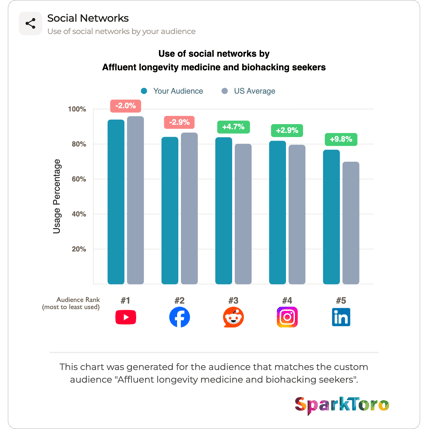
YouTube is #1. For affluent longevity seekers, YouTube is the top social platform, above Facebook, above Instagram. This audience watches long-form educational content. They want depth, not soundbites.
Reddit ranks #3 (above Instagram). These patients are reading Reddit threads about treatment experiences, provider recommendations, and protocol comparisons. They trust peer experiences over polished marketing.
LinkedIn over indexes too. This is an affluent, professional demographic. They're on LinkedIn more than the general population, which opens opportunities for thought leadership content.
If your marketing strategy is built around Instagram Reels and Facebook ads, you might be optimizing for the wrong audience entirely. The longevity patient wants education, depth, and peer validation, not lifestyle content.
What This Means for Your Practice’s Marketing Strategy
The fundamentals still matter. Educational content, clear service descriptions, strong reviews, proper schema markup, these signals help you rank in both traditional search and AI recommendations.
But there are specific optimizations for AI visibility that most practices aren't doing:
Content depth matters more than ever. AI models pull from comprehensive, authoritative content. Thin service pages won't cut it. You need content that actually answers the questions your patients are asking.
Reviews and mentions feed AI recommendations. The more your practice appears across trusted sources, directories, review sites, news mentions, podcast appearances, the more likely AI will surface you in recommendations.
Schema markup helps AI understand your practice. Structured data tells AI systems exactly what services you offer, where you're located, and what your credentials are. Most practices have minimal or no schema implementation.
Your Google Business Profile influences AI answers. AI models pull from GBP data for local recommendations. If your profile is incomplete or unoptimized, you're handicapping your AI visibility.
We've also seen that hormone therapy searches are booming in specific states, which creates both opportunity and competition depending on your market.
The Deeper Motivation
One more data point worth considering: OvationLab's research showed that "time with loved ones" is up 92% year-over-year as the primary motivation for longevity.
Your patients aren't just buying treatments. They're buying more years with their families. More time to watch their kids grow up, more adventures with their spouse, more presence in the lives of people they love.
That's the story your marketing should tell. Not just clinical outcomes, but what those outcomes mean for the life your patient wants to live.
Check Your AI Visibility
Want to see where your practice actually shows up in AI search?
We built an AI visibility audit that tests how your practice appears in ChatGPT, Claude, and Perplexity when patients search for services you offer. It shows exactly where you're visible, where you're not, and what's driving the gap.
Book a 15-minute AI visibility audit →
You can find more data from Laurie and Tom’s research at OvationLab.com.
FAQ: AI Search and Healthcare Marketing
Do patients really use AI to find doctors? Yes. Research shows affluent longevity and wellness seekers use AI search tools 18-32% more than the general population. They use AI to research treatments, compare providers, and interpret their own health data before booking appointments.
How do I show up in ChatGPT or Perplexity recommendations? AI models pull from multiple signals: your website content, reviews, directory listings, schema markup, and mentions across the web. Comprehensive, authoritative content and consistent business information across platforms improve your AI visibility.
Is Google still important for healthcare marketing? Absolutely. Google remains the dominant search channel. But AI search is growing rapidly, especially among affluent, research-driven patients. The best strategy optimizes for both.
What's the most important channel for longevity medicine marketing? Data shows YouTube is the #1 social platform for this audience, followed by Facebook and Reddit. Long-form educational content performs better than short-form social posts for reaching longevity-focused patients.
Ready to start attracting the new longevity-focused patient?
Get our free guide: Marketing Beyond Anti-Aging: The Practice Owner’s Guide to the $90B Longevity Economy.%20(2).png?width=337&height=380&name=V2%20Beyond%20Anti-Aging%20The%20Practice%20Owners%20Guide%20to%20the%20$90%20Billion%20Longevity%20Economy%20(US%20Letter)%20(2).png)